ADVANTAGES AND DISADVANTAGES OF BUBBLE SORT
The bubble sort algorithm works by repeatedly swapping adjacent element that are not in order until
the whole list of items in sequence.In this way,item can be seen as bubbling up the list according to their key values.
The primary advantage of the bubble sort is that it is popular and easy to implement.Moreover,in the bubble sort elements are swapped in place without using additional temporary storage,so the space requirements is at minimum.The main disadvantage of the bubble sort is the fact that it does not deal well with a list containing a huge number of items.This is because the bubble sort requires n-squared
processing steps for every n number of elements to be sorted.Such as ,the bubble sort mostly suitable for academic teaching but not for real life applications.
Monday, 3 November 2014


CORBA Data Flow
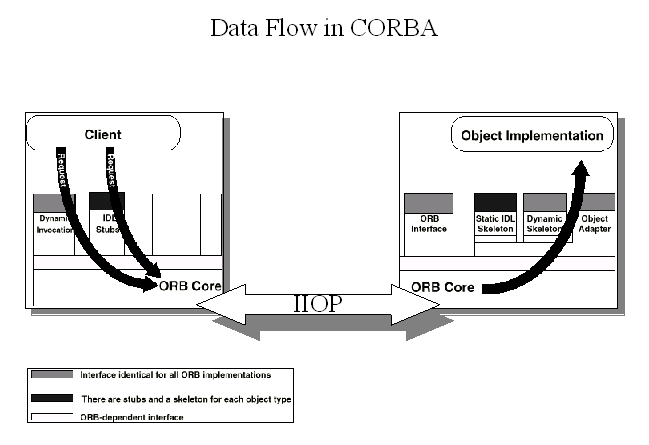
ORB :
- find the object implementation for the request,prepare the object implementation to receive the request and communicate the data making up the request.
- ORB throws exception
Object Implementation :
- provides ORB services to particular groups of object implementations.
IIOP : Internet Inter-ORB Protocol
- TCP/IP implementation of GIOP
Resources :
http://www.cs.rpi.edu/courses/fall02/netprog/notes/javacorba/javacorba.pdf
Cognitive Psychology
I read an article regarding cognitive psychology in which it relates the human mind to computer processing. It sparks my interest because for a moment, it is not completely off topic and kind of interesting.
The term "Cognitive Psychology" refers to the study of mental processes such as attention, language use, memory, perception, problem solving, creativity, and thinking.
The individual or the human brain itself is a processor of information, the same as how we see computer takes in information(input) and follows a program(process) to produce an output.

THEORETICAL
Based on further studies, several theory are written.
- Information made available by the environment is processed by a series of processing systems (e.g. attention, perception, short-term memory)
- These processing systems transform or alter the information in systematic ways
- The aim of research is to specify the processes and structures that underlie cognitive performance
- Information processing in humans resembles that in computers
COMPUTER - MIND ANALOGY

Cognitive psychologists describes the computer as an analogy to compare human mental processing. The computer analogy is the use of the computer as a tool for thinking how the human mind handles information.
The information processing approach characterizes thinking as the environment providing input of data, which is then transformed by our senses. The information can be stored, retrieved and transformed using “mental programs” with the results being behavioral responses.
Critical Evaluation
A number of models of attention within the Information Processing framework have been proposed including:
Broadbent's Filter Model (1958), Treisman's Attenuation Model (1964) and Deutsch and Deustsch's Late Selection Model (1963).
- The information processing models assume serial processing of stimulus inputs.
Serial processing effectively means one process has to be completed before the next starts.
Parallel processing assumes some or all processes involved in a cognitive task(s) occur at the same time - The analogy between human cognition and computer functioning adopted by the information processing approach is limited. Computers can be regarded as information processing systems insofar as they:
(i) combine information presented with stored information to provide solutions to a variety of problems
(ii) most computers have a central processor of limited capacity and it is usually assumed that capacity limitations affect the human attentional system - The evidence for the theories/models of attention which come under the information processing approach is largely based on experiments under controlled, scientific conditions. Most laboratory studies are artificial and could be said to lack ecological validity
- The Models proposed by Broadbent and Treisman are 'bottom-up' or ‘stimulus driven’ models of attention. Although it is agreed that stimulus driven information in cognition is important, what the individual brings to the task in terms of expectations/past experiences are also important. These influences are known as 'top-down' or 'conceptually-driven' processes
References : http://www.simplypsychology.org/information-processing.html
CORBA Reference Model Architecture
- The CORBA standard relies on a reference model named the OBject Management Archtecture (OMA)

A typical CORBA implementations includes:
- An object Request Broker (ORB) implementations
- An interface Definition Language (IDL) compiler
- Implementations of Common Object Service (COS) also called CORBA services
- Common Framework, also called CORBA facilities
- An internet Inter ORB Protocol (IIOP) implementation
Hyper-threading Technology's Benefits and Drawbacks
Assalamualaikum. Here, I would like to share the advantages and disadvantages of hyper-threading technology.

References:1.http://www.windowsnetworking.com/articles-tutorials/netgeneral/Intels-Hyper-Threading-Technology.html
2.http://en.wikipedia.org/wiki/Hyper-threading
3.http://www.slideshare.net/ankita_mistry/hyper-threading-13849335?related=4
Subscribe to:
Posts (Atom)